
Deep work is easier to admire than to repeat. Most people understand the value of uninterrupted concentration, yet their best intentions get scattered by open tabs, messages, household noise, and tasks that are too vague to begin. A timer helps, but a timer by itself is only a clock. The larger win comes from building a ritual around the timer so your brain receives the same cues every time you sit down to do serious work.
A good deep work timer ritual gives every session a clean shape. It tells you what you are working on, when the block begins, what sound environment you will use, what counts as distraction, and how you will recover afterward. That structure matters because attention is not controlled by willpower alone. It is shaped by friction, cues, environment, and the cost of switching away from the task. When the ritual is simple enough to repeat, focus becomes less dependent on mood.
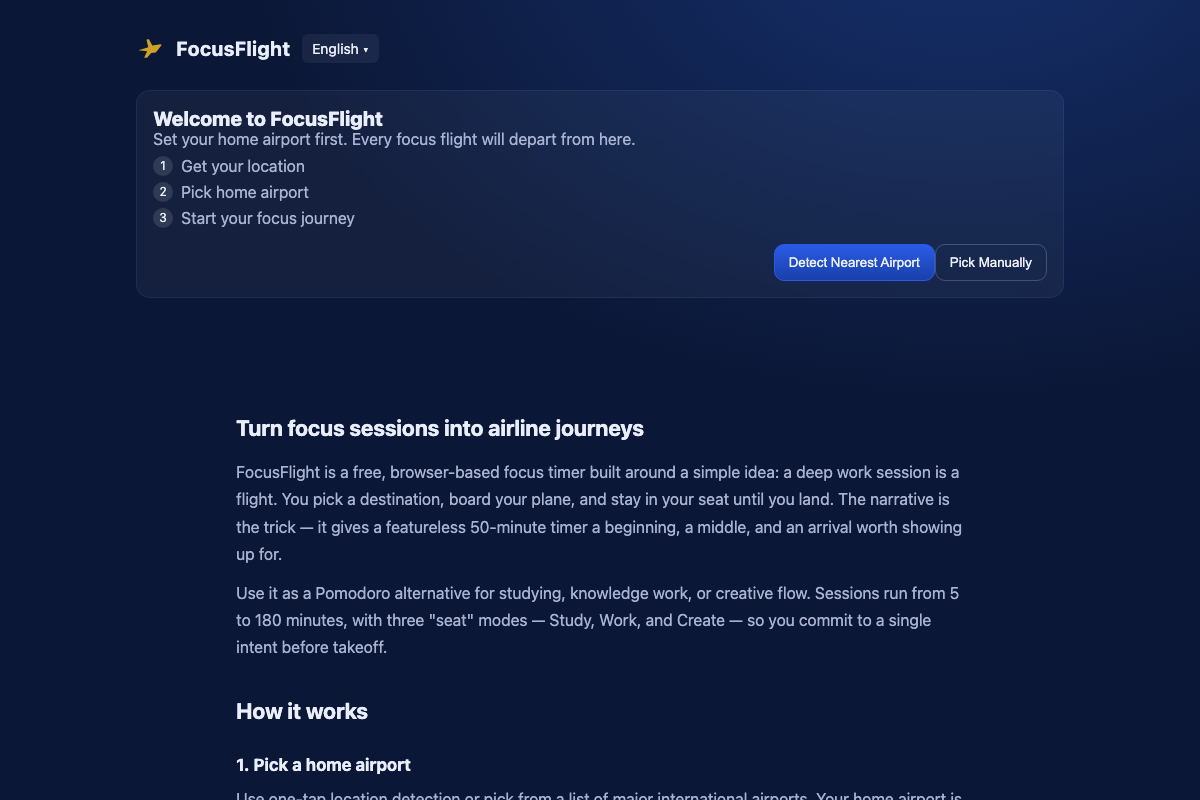
FocusFlight is built for this kind of routine. The timer creates a defined flight. Ambient sound softens the room. The session has a beginning, cruising period, and landing. Whether you use classic Pomodoro blocks, longer study sessions, or 90-minute deep work intervals, the same principle applies: make the start obvious, protect the middle, and use the break to reset instead of fragmenting your attention further.
Why Deep Work Needs a Ritual, Not Just a Timer
Starting a timer is useful because it creates a boundary. For the next 25, 50, or 90 minutes, you are asking your attention to stay in one place. The problem is that many people begin the timer before deciding what the session is actually for. They start with an intention like "work on project," "study biology," or "write report." Those labels are too broad. As soon as the work gets uncomfortable, the mind looks for a smaller, easier action nearby.
A ritual fixes that by narrowing the next action before the clock starts. Instead of "write report," the session becomes "draft the opening argument and add three supporting bullets." Instead of "study biology," it becomes "answer 20 active recall questions on cell signaling and mark weak topics." Specificity reduces negotiation. You do not waste the first third of the session deciding what work means.
This matches a broader point from Cal Newport's writing on deep work: high-value concentration depends on protecting cognitively demanding effort from interruption. The timer is one protection. The ritual around it is another. Together they create conditions where staying with the work is simpler than escaping it.
The Attention Cost of Broken Sessions
Interruptions feel small when they happen one at a time. A message preview, a quick tab switch, a nearby conversation, or a short check of a task board may seem harmless. The hidden cost is that attention does not always snap back into place. After switching context, you often need time to reconstruct what you were doing, what mattered, and what the next move should be.
In Mark, Gudith, and Klocke's experiment with 48 participants, interrupted participants completed simulated work faster but reported greater stress, frustration, time pressure, and effort. The result shows a cost beyond elapsed time, without establishing a fixed recovery period.
That is why a timer ritual should include rules for inputs. During the block, email is closed. Messaging apps are hidden. The phone is away from the desk. Nonessential browser tabs are gone. If a new thought appears, it goes onto a capture note without becoming the next task. These rules sound strict, but they remove constant micro-decisions. The less you negotiate, the more attention remains for the work that matters.
Choose the Right Timer Length for the Work
Not every focus block should be 25 minutes. The Pomodoro method is a strong starting point because it lowers resistance and makes a session feel manageable. For many students and remote workers, 25 minutes is the right unit for reading, problem sets, admin cleanup, flashcards, or starting a task that has been delayed for too long. Short blocks are especially helpful when the barrier is beginning.
Longer work needs different timing. A 50-minute block often works better for drafting, coding, planning, and difficult study because it gives the mind enough runway to settle in. A 75- to 90-minute block can be effective for strategy, research synthesis, or complex writing, but only when the task is already defined and your energy is high enough to sustain it. Long blocks with vague goals tend to become long periods of avoidance.
| Timer Length | Best For | Setup Requirement | Break Style | Common Mistake |
|---|---|---|---|---|
| 25 minutes | Starting hard tasks, review, flashcards, email cleanup | One small outcome | Five minutes away from the screen | Using the block for planning instead of doing |
| 50 minutes | Writing, coding, problem solving, focused study | A defined deliverable or section | Ten minutes of movement or water | Letting messages stay visible during the block |
| 90 minutes | Deep analysis, creative drafting, strategic work | Clear materials, high energy, no interruptions | Fifteen to twenty minutes of real recovery | Attempting it when tired or underprepared |
The best timer length is the one that matches the cognitive load of the task. Treat the interval as a design choice, not a productivity identity. If a 25-minute session gets you started, use it. If a 50-minute flight helps you reach meaningful depth, use that. If a longer session regularly collapses halfway through, shorten it until you can finish cleanly.
Use Ambient Sound as a Start Cue
Sound is powerful because it changes the room quickly. A steady layer of white noise, brown noise, rain, or airplane ambience can make a messy environment feel more predictable. It also gives the beginning of the session a sensory marker. When the sound starts, the focus block has started. Over time, that cue can become part of the habit.
White noise is useful when you need strong masking. It can soften hallway sounds, traffic, appliances, and fragments of conversation. Brown noise may feel gentler for longer sessions because it emphasizes lower frequencies. Airplane ambience can work especially well for deep work because it is steady without feeling as sharp as pure white noise. The right choice is the one that lets you stop monitoring the environment.
Volume matters. The CDC NIOSH noise guidance is focused on hearing safety, but it reinforces a practical point for concentration: sound level should be managed intentionally. For focus, ambient sound should be loud enough to mask irregular noise but quiet enough to fade behind the work. If the sound becomes tiring, lower it or choose a softer profile.
The Five-Minute Preflight Checklist
A deep work ritual does not need to be elaborate. In fact, it should be short enough that you can use it on an ordinary Tuesday when your energy is average. Five minutes is enough if each step removes a source of friction.
- Name the outcome. Write one sentence that describes what will be true when the session ends. Make it visible before the timer starts.
- Clear the inputs. Close apps, tabs, documents, and notifications that are not needed for the work.
- Prepare materials. Open the file, book, note, dataset, or reference you will actually use. Avoid searching after takeoff.
- Start the sound. Choose one ambient sound and keep it steady for the entire block.
- Start the timer. Once the clock begins, the only job is to move the defined task forward.
This checklist works because it prevents the most common focus leak: beginning before the task is ready. Preparation is not procrastination when it is bounded and specific. The danger is open-ended preparation, where you keep organizing the workspace to avoid the first hard sentence, problem, or decision.
Protect the Middle of the Session
The middle of a deep work block is where most routines fail. The novelty of starting has worn off, but the reward is not visible yet. This is the moment when people check a message, adjust the playlist, reorganize notes, or decide that a different task is more urgent. A strong ritual anticipates that dip.
One useful rule is to separate capture from action. If you remember an unrelated obligation, write it in a small capture note and return to the task. Do not open the calendar. Do not send the message. Do not search for the file. The capture note tells your brain that the thought is not lost, while the rule keeps the session intact.
Another rule is to make discomfort normal. Deep work often feels effortful before it feels productive. That does not mean the session is failing. It may mean you have reached the part of the task that requires real thinking. When that happens, stay with the smallest next move: write one rough paragraph, solve one step, summarize one source, or outline one decision. Momentum often returns after action, not before it.
Make Breaks Restore Attention
A break should help you return, not make returning harder. The fastest way to damage a focus routine is to spend every break inside a high-stimulation feed. Five minutes becomes twelve, the next session feels dull by comparison, and the ritual loses its rhythm. Breaks need boundaries just like work blocks do.
Good breaks are physical and low friction. Stand up. Stretch. Refill water. Look out a window. Walk around the room. If you are studying, avoid using the break to read more information. If you are writing, avoid opening another writing task. Let the brain release the current effort without creating a new attention problem.
For longer blocks, recovery matters even more. A 90-minute deep work session deserves a real landing: movement, food if needed, and a short note about what to do next. That note is valuable because it makes re-entry easier later. You are leaving a runway for the next session instead of forcing yourself to rediscover the work from scratch.
How Students Can Apply the Ritual
Students often have the hardest focus environment because their work mixes reading, memorization, problem solving, lectures, messages, and social pressure in the same spaces. A timer ritual creates separation. One block can be for active recall. Another can be for practice questions. Another can be for outlining an essay. Each session gets one job.
For exam prep, start with shorter blocks if anxiety is high. A 25-minute flight with ten practice questions is much easier to begin than an undefined afternoon of studying. Once momentum improves, use 50-minute sessions for deeper problem solving or essay planning. Track completed outputs rather than hours spent. The best evidence that a session worked is not how long you sat there; it is what you can now explain, solve, write, or remember.
The UNC Learning Center's study guidance emphasizes active approaches over passive rereading, which fits naturally with timer rituals. Use the timer to create active blocks: retrieve, solve, teach, outline, compare, and test. Passive exposure feels comfortable, but active work creates stronger learning signals.
How Remote Workers Can Apply the Ritual
Remote workers face a different challenge: availability. Messaging tools make it easy for the workday to become one long stream of partial attention. A timer ritual gives you a defensible boundary. When the session starts, your status can say that you are in a focus block until a specific time. That is clearer than simply disappearing, and it protects work that otherwise gets pushed into evenings.
Use the first deep work block of the day for the task that would be hardest to recover if interrupted. Strategy documents, architecture decisions, analysis, writing, and planning usually belong there. Save shallow work for scheduled communication windows. This rhythm works because it matches task type to attention quality instead of treating every hour as identical.
FocusFlight can make the boundary feel more concrete. Starting a flight is not just starting a clock; it is changing the state of the workspace. The ambient sound, visible timer, and defined landing point all reinforce the same message: this block has one purpose.
Common Mistakes to Avoid
The first mistake is turning the ritual into a project. If you need fifteen tools, three playlists, and a perfect desk before starting, the routine has become another barrier. Keep it small and repeatable.
The second mistake is using the timer to endure vague work. A countdown cannot rescue a task that has no next action. Define the outcome before you begin.
The third mistake is ignoring energy. Long deep work blocks are valuable, but they are expensive. Use them when rested. When energy is low, shorter blocks are more honest and often more productive.
The fourth mistake is treating breaks as rewards that can contain anything. Breaks are part of the system. If they scatter attention, they weaken the next block.
The fifth mistake is changing the routine after every imperfect session. Evaluate patterns over several days. One bad block may reflect sleep, stress, task difficulty, or timing. A ritual becomes useful through repetition and small adjustment.
Frequently Asked Questions
What is a deep work timer ritual?
It is a repeatable sequence you use before, during, and after a focused work block. It usually includes choosing one outcome, clearing distractions, starting ambient sound, running a timer, and taking a recovery break.
How long should a deep work timer be?
Use 25 minutes when starting is difficult, 50 minutes for most serious writing or study, and 75 to 90 minutes for demanding work when your task is clear and your energy is high.
Should I use white noise, brown noise, or airplane ambience?
Use white noise when you need stronger masking, brown noise when white noise feels too sharp, and airplane ambience when you want a steady background that feels natural across longer sessions.
What should I do if I get distracted during the timer?
Capture the distraction in a note if it matters, then return to the smallest next action in the original task. Avoid opening new apps or solving the distraction during the block.
Can FocusFlight replace a Pomodoro timer?
Yes. FocusFlight can support Pomodoro-style blocks as well as longer deep work sessions. The advantage is that the timer and ambient environment live together, which reduces setup friction.
A deep work ritual should make concentration feel less mysterious. You define one outcome, close the loops that usually pull you away, start a steady sound, and give the work a real boundary. The more often you repeat that sequence, the easier it becomes to enter a focused state without waiting for perfect motivation. Focus is still effortful, but the path into it becomes clearer.