
Most people do not struggle with the idea of focusing. They struggle with the timing of it. They know they should work in blocks, avoid constant context switching, and protect their most demanding tasks from interruption. Yet when the day actually begins, the plan is usually vague. One person tries to power through three straight hours and burns out after forty minutes. Another spends the entire day in short, reactive bursts that never become real concentration. A third keeps starting timers without deciding what kind of work each timer is meant to support.
A better approach is to treat focus like a schedule design problem. The goal is not to find one magical session length and force every task into it. The goal is to match the right timer length, break style, and sound environment to the work in front of you. Reading dense material, solving problem sets, drafting a report, planning a project, and reviewing email all place different demands on attention. When the timer fits the task, focus becomes easier to enter and easier to repeat.
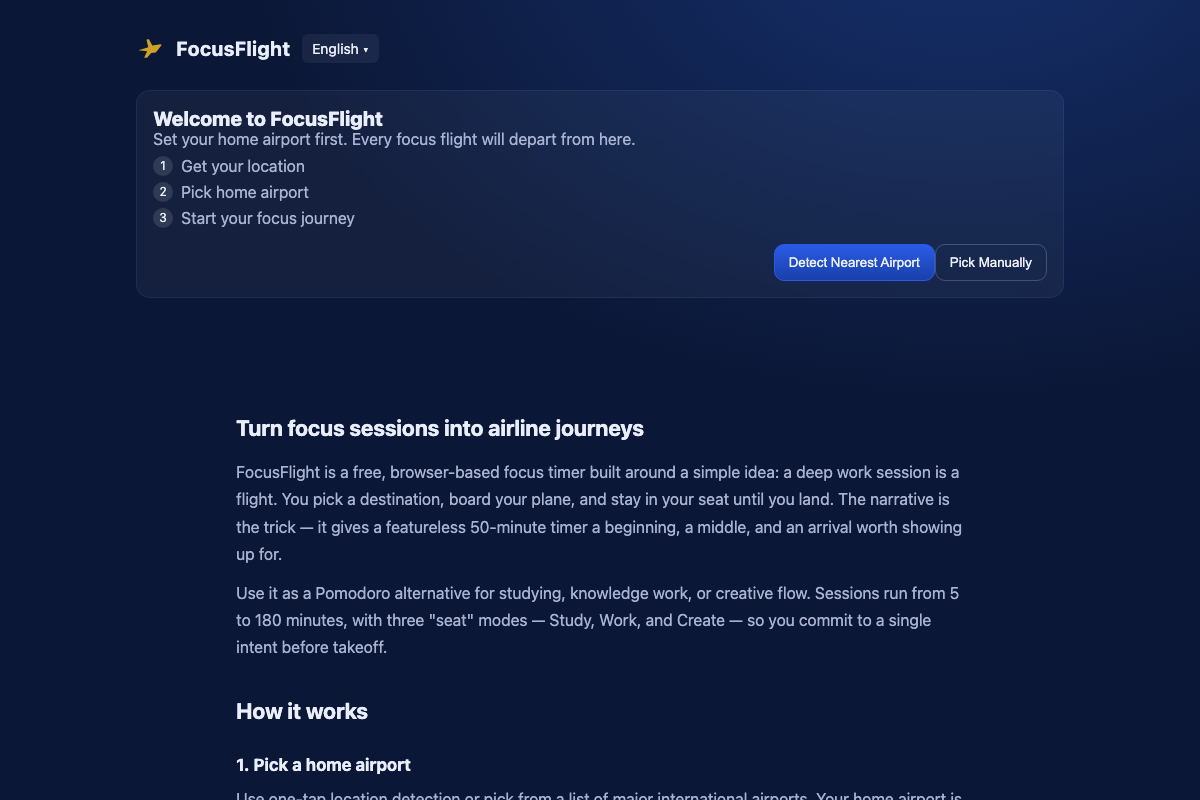
This is where a focus app becomes more useful than a simple countdown. FocusFlight gives each session a defined beginning and end, plus an ambient sound environment that helps the room feel less chaotic. Whether you prefer a classic Pomodoro, a 50-minute study block, or a longer deep work session, the timer should support the work instead of becoming another rule you resent. The best focus timer schedule is the one you can actually use on an ordinary day, even when your energy is imperfect.
Why Most Focus Schedules Break Down
The biggest mistake in time management is assuming that all productive work looks the same. It does not. Administrative tasks reward speed and batching. Deep work rewards continuity. Studying often alternates between memorization, problem solving, review, and self-testing. If you apply one uniform timing rule to every category, the schedule will eventually fight the task.
That mismatch shows up in predictable ways. Long sessions feel intimidating when you have not defined the next step. Short sessions feel frustrating when you are finally getting traction on a demanding problem. Breaks become unhelpful when they are either too short to reset attention or so open-ended that they dissolve the momentum of the day. Many people conclude that the timer method itself is flawed, when the real issue is that the schedule was never designed around cognitive load.
Writers on concentrated work such as Cal Newport have argued that high-value results depend on uninterrupted attention applied to demanding tasks. His overview of deep work is useful here because it frames focus as a condition that has to be protected, not just wished for. A timer helps create that condition, but only if the timer is paired with a clear task definition and a structure that fits the work.
Build Your Schedule Around Three Types of Work
Before choosing timer lengths, divide your day into three broad categories: startup work, sustained work, and shallow work. Startup work is any task where the hardest part is beginning. Sustained work is the cognitively demanding material you want to stay with for long enough to make meaningful progress. Shallow work includes communication, routine cleanup, scheduling, and small loose ends.
Startup work usually benefits from a short block because the obstacle is activation energy. A 25-minute Pomodoro is powerful here because it makes the first move feel small enough to attempt. Sustained work often needs a longer runway. Fifty minutes is long enough for writing, coding, studying, and analysis to become immersive without being so long that the session feels endless. Shallow work works best when batched into explicit windows so it does not bleed across the entire day.
When you think in these categories, your focus schedule becomes easier to maintain. You are no longer asking, "What timer should I always use?" You are asking, "What kind of work is this block meant to support?" That question produces better choices and reduces the guilt that comes from forcing every task into the wrong format.
A Practical Comparison of Focus Block Lengths
There is no single ideal session length, but there are clear tradeoffs. The comparison below is a better starting point than treating productivity advice as a personality test.
| Focus Block | Best Use Case | Main Advantage | Main Risk | Best Break |
|---|---|---|---|---|
| 25 minutes | Starting hard tasks, flashcards, review, short reading sprints | Low resistance and easy to repeat | Can end just as momentum appears | 5 minutes away from screens |
| 50 minutes | Writing, coding, active study, analysis, problem solving | Enough time to settle into the task | Requires a clearly defined outcome | 10 minutes of movement or water |
| 75 to 90 minutes | Deep strategy, long-form drafting, advanced study sessions | Supports deeper immersion | Fails quickly if energy or setup is weak | 15 to 20 minutes of real recovery |
The useful question is not which row looks most impressive. The useful question is which row best matches the task and your current energy. A short block is not inferior if it gets the work moving. A longer block is not superior if you spend half of it recovering from poor setup or resisting distraction.
The Best Daily Focus Timer Schedule for Most People
For students, remote workers, freelancers, and knowledge workers, a practical daily schedule often looks like this: begin with one short startup block, move into one or two sustained blocks during your best energy window, batch shallow work into smaller windows, then use another sustained block later if needed. This pattern protects your best attention instead of scattering it across the whole day.
Here is one realistic template. Start the day with a 25-minute block on the task you have been avoiding. The goal is not perfection. The goal is to create movement. After a short break, shift into a 50-minute block for your most important demanding task. If your energy remains strong, repeat that 50-minute format once more. Then move communication, inbox review, and other shallow tasks into a bounded window. Later in the day, choose either another 50-minute block or a lighter 25-minute session depending on your energy and the type of work left.
For a recurring time anchor, UNC's study guide recommends planning the week and assigning specific daily tasks. Use that planning practice to reserve a repeatable study window.
This schedule works because it aligns your attention with the job instead of flattening the day into identical units. It also leaves room for actual life. Meetings happen. Classes move. Energy dips. If the schedule has only one acceptable version, it will fall apart the first time reality interferes. A good focus schedule should bend without collapsing.
How the Pomodoro Method Fits Into a Larger System
The Pomodoro method remains useful because it solves a specific problem very well: hesitation. Twenty-five minutes is short enough that your brain is less likely to negotiate. It is especially effective for starting a reading assignment, clearing review cards, outlining a paper, or beginning a task you have delayed for too long. The mistake is assuming that Pomodoro should govern every hour of meaningful work.
Used well, Pomodoro becomes the front door to deeper concentration. A student might use one 25-minute block to begin chemistry problems, then extend into a 50-minute session once the work is fully underway. A remote worker might use a morning Pomodoro to open a blank document and draft the outline, then shift into a longer block for the actual writing. In that sense, Pomodoro is often the ignition system, not the entire engine.
If you already rely on structured intervals, it helps to understand why sound and session design matter too. The relationship between short timed blocks and controlled sound is part of what makes routines like Pomodoro with white noise more sustainable than a timer alone. The structure lowers resistance, while the sound environment reduces the chance that random noise pulls you out of the block.
Use Sound to Make the Schedule Easier to Repeat
Many people think about focus as if it lives only in willpower, but the environment matters just as much. If the room keeps changing, your attention keeps rechecking the room. That is why steady ambient sound can be so helpful. White noise, brown noise, rain, and airplane ambience all create a more predictable background, which makes it easier to stay with a single task.
The APA describes four task-switching experiments in which switches took longer for complex or unfamiliar tasks. That is a reason to protect demanding work from avoidable switching; it does not establish an ideal two-hour session.
Volume and duration matter. A sound layer should fade behind the task rather than dominate it. Safety guidance from CDC NIOSH is aimed at hearing protection, but it also supports the basic point that sound should be managed intentionally, not blasted by default. If your ambient sound feels tiring after twenty minutes, it is too loud or too sharp for a long session.
How Students Should Schedule Focus Blocks
Students often make one of two mistakes. They either plan marathon study sessions that are too vague to start, or they fragment the day into so many tiny intervals that nothing difficult gets enough time. A better student schedule uses different block types for different tasks. Short blocks work well for recall practice, flashcards, and warm-up review. Medium blocks work well for problem sets, writing, reading with annotation, and active recall. Longer blocks work best for exam prep only when the materials are ready and the task is specific.
For example, a student preparing for exams could begin with a 25-minute review of weak topics, then move into two 50-minute sessions for practice questions and written correction. After lunch, a lighter 25-minute block might be enough for flashcards or summary notes. What matters is that every session has one job. "Study history" is too broad. "Outline the causes of the French Revolution from memory and fill gaps from the textbook" is concrete enough to focus on.
This approach also matches advice from study support centers that emphasize active work over passive rereading. The UNC Learning Center recommends studying in ways that require retrieval and application rather than just exposure. Timed blocks are useful because they let you define a narrow active task, finish it, and move to the next one with less drift.
How Remote Workers Should Schedule Focus Blocks
Remote workers face a different challenge: constant availability pressure. Messages, email, status updates, and low-grade digital chatter can consume the entire day without producing much meaningful output. In that environment, the best timer schedule is one that clearly separates deep work from communication windows.
A strong pattern is to protect the first serious block of the day before opening every channel. That block may be 50 minutes or 90 minutes depending on the task, but it should be reserved for work that is hardest to recover once interrupted. Writing, planning, coding, analysis, and difficult decision-making belong here. Communication can wait until the block is complete. After that, you can batch shallow work into a defined window, then return to another sustained block later.
If you work from home, visible boundaries help. Set your status. Close inboxes. Put the phone away. Start one ambient sound profile and keep it steady for the full session. FocusFlight is useful here because the timer and the sound cue arrive together, which makes the start of the session feel more concrete than a silent countdown running in the corner of a cluttered screen.
What to Do During Breaks So the Schedule Keeps Working
A focus schedule fails as often in the break as it does in the work block. If every five-minute break turns into a high-stimulation scroll, the next session will feel flat and hard to enter. The purpose of the break is recovery, not attention whiplash.
Short breaks should be physical and simple. Stand up. Stretch. Refill water. Step outside for a minute. Look at a faraway point instead of another screen. Longer breaks should include a more complete reset: a walk, food, quiet, or a short written note about what comes next. That note matters because it reduces friction when the next timed block begins.
The American Academy of Ophthalmology recommends periodically looking away from the screen at a distant object. This supports an eye break, not a claim that a particular microbreak restores deep attention.
If you consistently struggle to restart after breaks, the answer is not always more discipline. Often the answer is a better break boundary or a shorter break. Test small changes. A schedule becomes reliable through adjustment, not through forcing one rigid version forever.
Common Mistakes That Ruin Otherwise Good Timer Plans
The first mistake is choosing a session length for identity reasons instead of practical reasons. Long sessions can sound serious, but they are wasteful if the task is unclear or your energy is poor. The second mistake is starting the timer before the materials are ready. Searching for notes, opening documents, and deciding what the task means should happen before takeoff, not after.
The third mistake is mixing deep work and shallow work in the same block. If you begin a writing session but spend half the time answering messages and checking references that could have waited, the timer is no longer protecting attention. The fourth mistake is assuming that one rough block means the whole method failed. Focus is affected by sleep, stress, difficulty, hunger, and environment. Judge the schedule over days, not minutes.
The fifth mistake is forgetting that repetition matters more than novelty. The best schedule is rarely the cleverest one. It is the one you can repeat on a regular Tuesday, in a noisy apartment, with limited motivation, and still make progress.
Frequently Asked Questions
What is the best focus timer length for deep work?
There is no universal best length established here. Try a manageable block, review the work completed and your comfort, and adjust the next interval. The durations in this guide are scheduling examples.
Should I always use Pomodoro for studying?
No. Pomodoro is excellent for getting started, quick review, and reducing procrastination, but many study tasks benefit from 50-minute blocks once you are engaged. Use the interval that matches the work rather than treating one method as a rule for everything.
How many focus sessions should I do in a day?
Most people do better with two to four meaningful focus sessions than with an all-day attempt at concentration. The exact number depends on your task load, energy, meetings, and life constraints, but a smaller number of protected sessions usually beats constant partial attention.
Is white noise or brown noise better for focus?
White noise tends to mask sharp environmental sounds more aggressively, while brown noise often feels softer over longer sessions. The best option is the one that helps the room fade into the background without becoming tiring or distracting on its own.
How do I know if my timer schedule is working?
Look at outputs, not just elapsed time. If the schedule helps you complete reading notes, solve practice questions, draft sections, or finish meaningful chunks of work with less friction, it is working. If you regularly end blocks without clear progress, adjust the task definition, block length, or break structure.
A strong focus timer schedule does not need to be complicated. It needs to respect the difference between starting, sustaining, and recovering. Use short blocks to break inertia, medium blocks to do serious work, longer blocks only when the task truly deserves them, and breaks that actually restore attention. When the schedule fits the task, concentration stops feeling like a daily argument and starts feeling like a system you can trust.