
Body doubling is one of the simplest focus strategies on the internet, but it is also one of the most misunderstood. At its core, body doubling means doing your work while another person is present, either physically or virtually, so their presence helps you start, stay on task, and finish. The other person does not need to coach you, manage you, or even work on the same task. Their role is more subtle: they anchor your attention. For students, remote workers, freelancers, and anyone who struggles with task initiation, that anchor can make the difference between scrolling for 45 minutes and finishing a meaningful block of work.
Body doubling means working alongside another person, in person or remotely, while each person works on their own task. Treat it as a format to try rather than assuming that social-facilitation theory establishes its effectiveness for every person with or without ADHD.
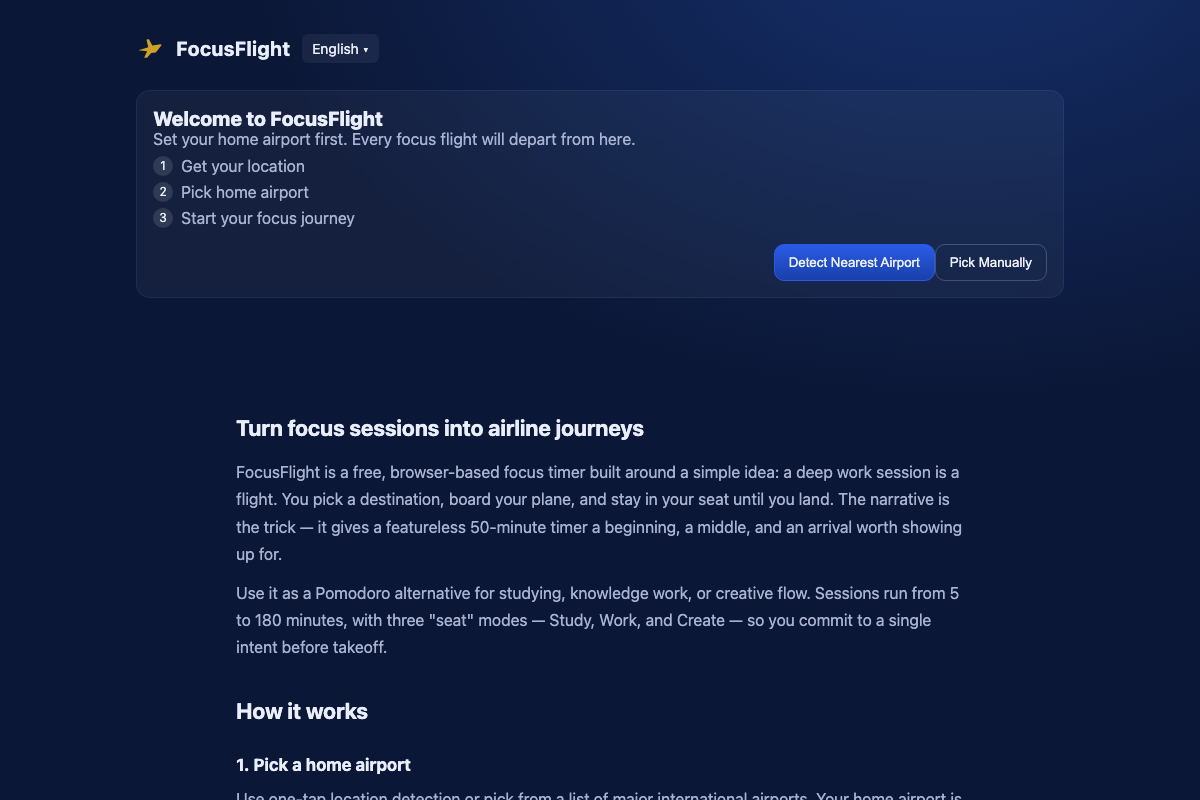
For FocusFlight users, body doubling is especially useful because the app already provides time structure, immersive airplane ambience, and a strong start-and-finish ritual. Add another human being to that environment and the session becomes easier to enter and harder to casually abandon. If you already liked the ideas in our guides to deep work vs shallow work, staying focused while working from home, and airplane white noise for concentration, body doubling is the next practical layer to add.
What to Look For When Trying Body Doubling
Before a session, choose what to attempt and how you will assess it. Notice whether the arrangement helps you start, stay with the task, and return after a break; another person's presence can also be distracting.
When another person is present, four useful things happen. First, the work becomes more real because it has entered a shared social space. Second, you become less likely to drift into low-effort distraction because your attention is no longer completely private. Third, transitions become easier because you have an external cue for when the session begins and ends. Fourth, the session feels less lonely, which matters more than many productivity systems admit. Loneliness and low accountability often look like procrastination from the outside.
A 2025 preprint tested 12 participants with ADHD on a VR bricklaying task, alone and with human or simulated AI partners. Faster completion and better self-reported attention with partners are preliminary results; they do not establish that libraries, video calls, or every shared workspace improve performance.
Who Benefits Most from Body Doubling?
Body doubling is strongest for people who do not necessarily lack skill, but who struggle with consistency. That includes students who know the material yet cannot sit down to revise, knowledge workers who keep context-switching, creators who avoid the first draft, and remote workers whose day dissolves into messages and tabs. It is also useful for people who feel mentally tired by the thought of working alone for long periods.
If you recognize any of these patterns, body doubling is worth testing:
- You spend 20 minutes preparing to work and almost no time actually working.
- You tell yourself you will start after one more email, one more video, or one more quick task.
- You focus well in cafes, libraries, or airplanes, but poorly at home.
- You do better when someone expects an update from you.
- You find that the hardest part of work is the first 10 minutes.
Body doubling will not turn every task into deep work. It is not a cure-all, and it cannot fix severe sleep deprivation, unclear priorities, or a fundamentally broken workload. What it can do is create enough friction against avoidance that you finally enter the task. Once that happens, your own concentration systems can take over.
Body Doubling vs Other Focus Methods
One reason body doubling works so well is that it solves a different problem than a normal timer. Timers are excellent for defining duration. Ambient sound is excellent for masking distraction. Website blockers are excellent for reducing temptation. Body doubling is different: it changes the social conditions under which focus happens. That makes it especially effective when your issue is not lack of planning but lack of follow-through.
| Method | Best For | Main Strength | Main Limitation |
|---|---|---|---|
| Body doubling | Starting work and staying accountable | Uses social presence to reduce avoidance | Requires another person or scheduled session |
| Time blocking | Planning a full day | Reduces decision fatigue | Does not guarantee you will start |
| Website blockers | Digital distraction control | Removes easy temptations | Cannot create motivation by itself |
| White or brown noise | Noisy environments | Masks irregular sound | Does not add accountability |
| FocusFlight timer | Structured sessions with a clear finish | Combines timing, ambience, and progress cues | Works best when you still choose to begin |
| Body doubling + FocusFlight | Reliable, repeatable focus sessions | Pairs accountability with clear time structure | Needs a simple routine to use consistently |
How to Set Up a Body-Doubling Session
The setup matters. Many people fail with body doubling because they make it too vague. "Let us work together sometime" is not a system. A good body-doubling session is lightweight, repeatable, and explicit.
Start with a 30- to 60-minute block. Agree on one clear task before the session begins. Decide whether the session is silent or includes check-ins. Then start at a specific time, not a fuzzy one. The goal is to remove ambiguity. A useful script is: "At 2:00 PM, let us both start a 45-minute session. I am drafting the report introduction. We will check in again at 2:45." That is enough structure for most people.
There are three common formats:
- In-person silent work: Ideal for libraries, study rooms, or shared desks. Minimal talking, visible effort, quick check-in at the start and end.
- Video body doubling: Cameras on, microphones muted, each person works on their own task. This is one of the easiest options for remote workers.
- Async accountability with timers: You both start the same timer and report results at the end by message. This is weaker than live presence, but still better than working entirely alone.
If you are using FocusFlight, the cleanest routine is this: define the task, pick the flight length, start the flight together, and do not message during the session unless there is a genuine problem. The app supplies the shared countdown and the audio environment; the other person supplies social presence. That combination is strong because it covers both the psychological and environmental sides of focus.
Why Virtual Body Doubling Still Works
People sometimes assume virtual sessions are inferior because the other person is not physically in the room. In many cases, they work just as well. What matters is not physical closeness by itself, but the felt presence of another mind sharing the same window of effort. A live camera, a shared timer, or even a visible status indicator can be enough to change behavior. This is one reason virtual coworking communities continue to grow: they create structure without requiring travel.
Virtual body doubling also solves a practical problem. Many productive adults do not have a classmate, partner, or coworker available on demand. A standing 9:00 AM video session three times per week is much more sustainable than waiting for motivation to appear. Consistency beats intensity here. A reliable 45-minute session every weekday often outperforms a heroic three-hour session once a week.
Common Mistakes That Make Body Doubling Fail
Body doubling is simple, but the failure modes are predictable. The biggest mistake is turning it into a chat session. If the social energy of the other person pulls you away from the task, you have replaced accountability with distraction. The second mistake is choosing tasks that are too vague. "Work on my project" is not a clear start point. "Write the first 300 words of the project brief" is.
Other common errors include:
- Scheduling sessions when your energy is predictably low.
- Picking a partner who is unreliable, late, or highly distracting.
- Using the session to plan work instead of do work.
- Making the block too long at the start. Ninety minutes is too much for many beginners.
- Skipping the end-of-session recap, which removes the accountability loop.
There is also an important fit issue. Some people feel pressured rather than supported by social presence, especially on novel or emotionally loaded tasks. If that is you, use body doubling for execution, not for the most vulnerable stage of creative work. For example, use it to process email, revise an outline, or clean up a draft, but do the most exploratory thinking alone first.
How to Pair Body Doubling with FocusFlight
FocusFlight adds exactly the kind of structure body doubling benefits from. A session with another person works better when the start is unambiguous, the duration is visible, and the environment discourages random switching. FocusFlight provides all three.
A practical workflow looks like this:
- Name the task: each person states one concrete deliverable for the next session.
- Choose a flight length: 25 minutes if you need a low-friction start, 45 to 60 if you are already warm, 90 if the task clearly qualifies as deep work.
- Use cabin ambience or headphones: this helps mask household noise and creates the sealed-in feeling many people need for sustained concentration.
- Keep the cockpit clean: close nonessential tabs and put your phone out of reach before takeoff.
- Debrief on landing: share what you completed, what blocked you, and whether you are starting another flight.
This system works because it reduces the number of decisions you need to make while your willpower is weakest. You are not deciding whether to start every five minutes. You already started. You are already in the air.
If your main issue is distraction at home, pair body doubling with the sound strategy from our article on airplane white noise. If your issue is messy task selection, borrow the planning ideas from deep work vs shallow work. If your issue is remote-work fragmentation, combine this method with the schedule rules in our work-from-home guide. The point is not to worship one technique. The point is to assemble a reliable focus system.
How to Know If Body Doubling Is Working
You do not need complex analytics. Track three simple numbers for two weeks: how often you started on time, how many focused minutes you completed, and whether you finished the intended task. If those numbers improve, the method is working. The most important metric is often not total hours but reduced delay. If you used to start at 10:40 and now you start at 10:05, that is a major improvement.
Many people also notice softer signals: less dread before work, fewer false starts, less compulsive tab-switching, and a cleaner mental transition into effort. Those changes matter because they compound. A method that makes starting easier four times per week can change your output far more than a perfect productivity system you use once.
When Body Doubling Is Better Than Working Alone
Working alone is still valuable. Solitude is often better for reflection, high-stakes creative exploration, and any task where you need to think without self-consciousness. But body doubling is often better when you are stuck in the gap between intention and action. That gap is where many people lose most of their productive time.
Use body doubling when the task is clear but your follow-through is weak, when the environment is distracting, when you are recovering from a slump, or when you need a clean re-entry into disciplined work. Use solitude when the task is emotionally delicate, conceptually open-ended, or already moving well. The best workers do both. They do not argue about methods in the abstract; they choose the one that fits the bottleneck.
Frequently Asked Questions
Does body doubling actually help you focus?
Yes, for many people it does. The method works best when the real problem is task initiation, inconsistency, or distraction rather than lack of knowledge. A 30- to 60-minute body-doubling session often creates enough social accountability to reduce procrastination and keep attention on one task.
Do you need ADHD for body doubling to work?
No. Body doubling is popular in ADHD communities because external structure can support attention regulation, but the mechanism is broader than ADHD alone. Students, remote workers, founders, and freelancers often benefit from the same social-presence effect even without a diagnosis.
What is the best length for a body-doubling session?
Start with 25 to 45 minutes if you are new to the method. That range is long enough to build momentum but short enough to feel easy to begin. Once the habit is stable, many people move to 60- or 90-minute blocks for more demanding work.
Is virtual body doubling as effective as in-person body doubling?
It can be. A live video session with cameras on and microphones muted is often sufficient because the key ingredient is social presence, not physical proximity. For many remote workers, three virtual sessions per week are more realistic than one in-person session, and consistency usually matters more than format.
How should I use body doubling with FocusFlight?
Set one concrete task, choose a flight length, start the session together, and recap when the timer ends. A 45-minute FocusFlight session plus one accountability check at the end is a strong baseline. If home noise is a problem, keep the cabin ambience on through the entire block.
If you want a focus method that does not depend on motivation showing up first, body doubling is one of the highest-leverage options available. It is simple, cheap, and easy to test. Pair it with a structured timer, a clean environment, and a clear task, and you can turn "I should start" into actual movement. That is the real win. Not a prettier to-do list. Not better intentions. Real minutes of focused work, completed on time.