
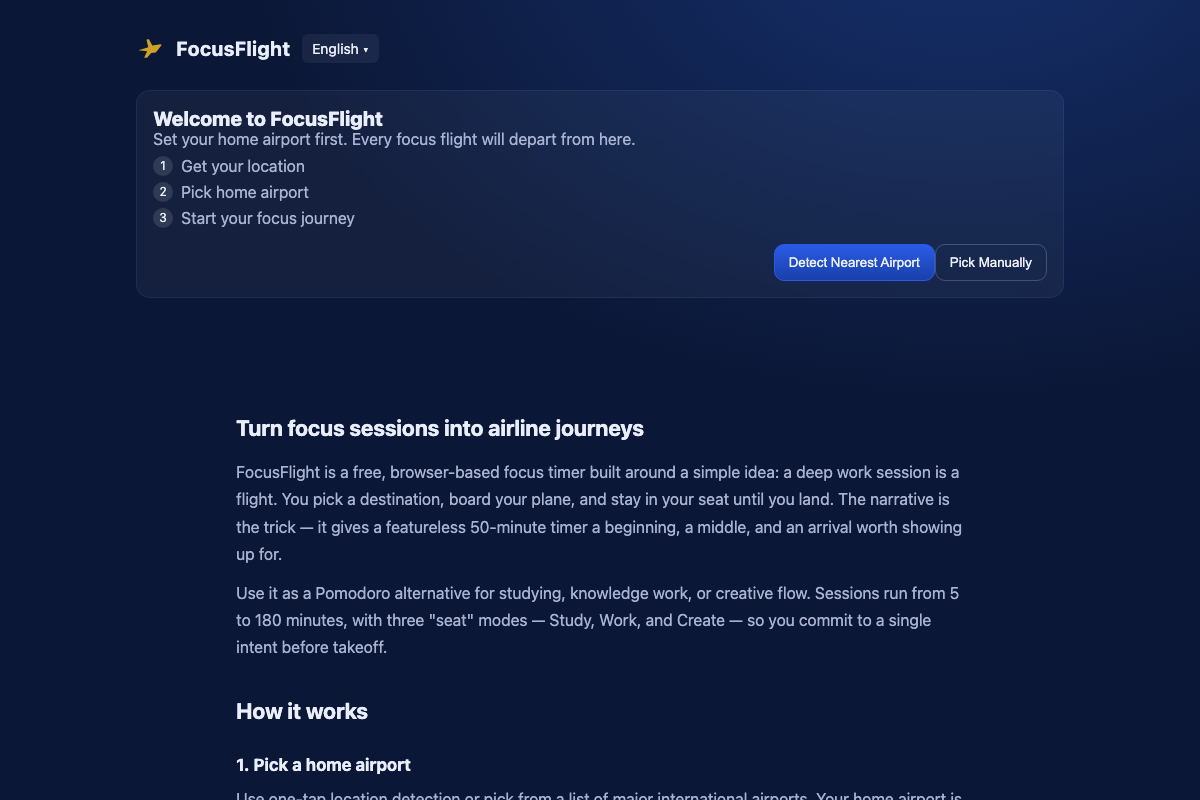
The Pomodoro Technique is one of the most popular productivity methods ever created. Developed by Francesco Cirillo in the late 1980s, it uses a simple kitchen timer to break work into focused intervals, traditionally 25 minutes long, separated by short breaks. Millions of students, developers, and professionals swear by it. But after decades of use, many people discover a frustrating truth: the basic Pomodoro timer gets boring. That is where FocusFlight comes in.
What Is the Pomodoro Technique?
At its core, the Pomodoro Technique is a time management method built on a single idea: your brain works best in focused bursts. Here is how the classic method works:
- Choose a task you want to work on.
- Set a timer for 25 minutes (one "Pomodoro").
- Work with full focus until the timer rings.
- Take a 5-minute break.
- After four Pomodoros, take a longer 15-30 minute break.
The method works because it reduces the psychological weight of a large task. You are not writing a 10,000-word thesis. You are just focusing for 25 minutes. That mental reframe is powerful.
Why Basic Pomodoro Timers Fall Short
While the Pomodoro Technique is effective, the standard implementation has some well-documented problems:
- Timer anxiety: Watching a countdown can create stress rather than focus. Your attention drifts to the ticking clock instead of your work.
- No engagement: A plain digital timer offers zero sensory stimulation. There is nothing to anchor you in the moment.
- Rigid intervals: Not every task fits neatly into 25-minute blocks. Deep coding sessions, academic writing, and creative work often require longer sustained focus.
- No reward loop: When the timer ends, you get a beep. That is it. No sense of achievement, no progression, no reason to start another session.
Research published in the Journal of Applied Psychology confirms that environmental cues, like ambient sounds and visual progress indicators, significantly improve sustained attention. A bare countdown timer ignores this entirely.
How FocusFlight Reinvents the Focus Timer
FocusFlight takes the core principle behind the Pomodoro Technique, timed focused work, and wraps it in an aviation-themed experience that actually makes focusing enjoyable.
1. Choose Your Flight Duration
Instead of being locked into 25-minute blocks, FocusFlight lets you select a destination airport. Each destination represents a different focus duration based on real flight times. Want a quick sprint? Pick a short domestic route. Need a deep work session? Choose an intercontinental flight. This flexibility means the technique adapts to your work, not the other way around.
2. Immersive Ambient Audio
The moment your flight takes off, you are enveloped in airplane cabin white noise. This is not random background sound. Airplane cabin noise operates at a specific frequency range (around 80-85 dB with a dominant low-frequency spectrum) that has been shown to mask distracting sounds while remaining non-intrusive. Studies from the Journal of Consumer Research found that moderate ambient noise actually enhances creative thinking.
3. Visual Progress That Motivates
Instead of a stark countdown, FocusFlight shows your airplane moving along a progress bar. You see your flight departing, cruising, and landing. This visual metaphor taps into the brain's reward system. You are not just waiting for a timer to end. You are completing a journey.
4. Gamified Progression System
Every completed flight unlocks new destinations. Start with domestic routes and work your way up to international flights. This progression system creates a dopamine feedback loop that keeps you coming back. Research on gamification in education shows that progression mechanics can increase engagement by up to 48%.
FocusFlight vs Traditional Pomodoro Apps
| Feature | Traditional Pomodoro | FocusFlight |
|---|---|---|
| Timer flexibility | Fixed 25 min | Any duration via flight routes |
| Ambient sound | None or basic | Authentic airplane white noise |
| Visual feedback | Countdown numbers | Animated flight progress |
| Gamification | None | Destination unlocking system |
| Motivation | Self-discipline only | Journey completion + rewards |
| Cost | Free-$5/mo | 100% Free |
How to Use FocusFlight with the Pomodoro Technique
You do not have to abandon the Pomodoro framework to use FocusFlight. Here is how to combine them:
- Pick a short-haul flight (approximately 25 minutes) for your Pomodoro sessions.
- Complete the flight with full focus on your task.
- Land and take your 5-minute break.
- After four flights, take a longer break and admire your unlocked destinations.
For tasks that demand deeper focus, skip the Pomodoro structure entirely and book a long-haul flight. As Cal Newport describes in Deep Work, sustained concentration on cognitively demanding tasks requires uninterrupted blocks well beyond 25 minutes. The ambient sound and visual progress will carry you through a 90-minute deep work session without the jarring interruption of a 25-minute alarm.
The Science Behind Why FocusFlight Works
FocusFlight is not just a clever theme layered on a timer. Every design choice is grounded in cognitive science:
- White noise masking: Airplane cabin noise provides consistent broadband sound that masks irregular distractions (conversations, traffic, notifications), keeping your auditory cortex in a steady state.
- Flow state induction: The combination of a clear goal (complete the flight), immediate feedback (progress bar), and a balanced challenge level (chosen duration) matches the three conditions Csikszentmihalyi identified for flow states.
- Variable reward scheduling: The destination unlock system uses intermittent reinforcement, the same psychological principle that makes games engaging, to maintain long-term motivation.
- Narrative transportation: Framing a work session as a "flight" activates narrative processing in the brain, making the experience feel less like grinding and more like an adventure.
Tips for Getting the Most Out of Your Focus Flights
- Start with shorter flights. If you are new to focused work, begin with 15-20 minute domestic routes and gradually increase duration.
- Use headphones. The airplane ambient sound is most effective through headphones, which provide additional passive noise isolation.
- Set your task before takeoff. Decide exactly what you will work on before starting your flight. Ambiguity kills focus.
- Try Pure Mode. FocusFlight's Pure Mode hides all controls, leaving only the timer and progress bar. Fewer visual distractions mean deeper focus.
- Track your flights. Notice which durations work best for different task types. You will develop a personal flight schedule optimized for your work style.
Frequently Asked Questions
Is FocusFlight free?
Yes, FocusFlight is completely free. There are no premium tiers and no subscriptions.
Can I use FocusFlight on mobile?
Absolutely. FocusFlight is a Progressive Web App (PWA) that works on any device with a browser. You can also install it on your home screen for an app-like experience.
Does FocusFlight replace the Pomodoro Technique?
Not necessarily. FocusFlight enhances the Pomodoro Technique by adding engagement and flexibility. You can use standard 25-minute intervals or customize your focus duration to match your task.
How does airplane white noise help concentration?
Airplane cabin noise provides a consistent, broadband sound that masks irregular environmental distractions. This type of noise has been shown in peer-reviewed studies to improve sustained attention and reduce the cognitive cost of filtering out background sounds.
What makes FocusFlight different from other focus apps?
FocusFlight combines three elements that most focus apps lack: authentic ambient airplane audio, visual flight progress tracking, and a gamified destination unlock system. Together, these create an immersive experience that makes focused work genuinely enjoyable.