
Finding the right study timer technique can be the difference between a productive session and hours of wasted time. The problem is that most study advice gives you one method and tells you it works for everything. In reality, different tasks, energy levels, and subjects demand different approaches. Here are 10 study timer techniques that are backed by research, with specific guidance on when each one works best.
1. The Pomodoro Technique (25/5)
The classic. Work for 25 minutes, break for 5. After four rounds, take a 15-30 minute break.
Best for: Repetitive tasks, flashcard review, reading assignments, and getting started when motivation is low.
Why it works: The 25-minute interval is short enough that almost anyone can commit to it. The frequent breaks prevent fatigue and give you regular opportunities to check in on your progress.
Limitation: The rigid 25-minute window can interrupt flow states during complex tasks like essay writing or problem sets.
FocusFlight tip: Use a short domestic flight (like SFO to LAX) for a Pomodoro-length session with added immersion.
2. The 52/17 Method
Work for 52 minutes, break for 17. This ratio was identified by the productivity tracking app DeskTime as the pattern used by their most productive users.
Best for: Professional work, coding, and any task where you need more sustained focus than Pomodoro allows.
Why it works: The nearly 1-hour work block allows you to reach and sustain a flow state. The 17-minute break is long enough for genuine recovery, including walking, stretching, or getting a snack.
Limitation: The longer work period can be intimidating for people who struggle with sustained attention.
3. The 90-Minute Focus Block
Work for 90 minutes, then take a 20-30 minute break. This aligns with your body's ultradian rhythm, the natural 90-minute cycles of alertness and rest that govern your day.
Best for: Deep work tasks like thesis writing, complex problem-solving, or learning difficult new material.
Why it works: Sleep researcher Nathaniel Kleitman discovered that our bodies cycle through 90-minute periods of higher and lower alertness throughout the day (the Basic Rest-Activity Cycle). Working in alignment with this natural rhythm optimizes cognitive performance.
Limitation: Requires significant sustained attention. Not ideal for boring or low-engagement tasks.
FocusFlight tip: Book a long-haul international flight for a full 90-minute deep work session.
4. Time Blocking
Pre-assign specific time blocks to specific tasks throughout your day. For example: 9:00-10:30 = Chapter 5 reading, 10:45-12:00 = Problem set, 1:00-2:30 = Essay draft.
Best for: Days when you have multiple different tasks to complete and need structure to prevent one task from consuming all your time.
Why it works: Time blocking eliminates the constant decision-making about what to work on next. Decision fatigue is a real cognitive drain, and pre-planning your blocks removes it entirely.
Limitation: Requires planning in advance. Interruptions can cascade through your entire schedule.
5. The Flowtime Technique
Start working and let yourself continue for as long as you are in a flow state. When you feel your focus breaking, stop and take a proportional break (roughly 1 minute of break per 5 minutes of work).
Best for: Creative tasks, programming, art, music, and any work where interrupting flow is costly.
Why it works: It respects your natural focus rhythms instead of imposing artificial boundaries. Some sessions will be 15 minutes, others might stretch to 2 hours. The technique adapts to you.
Limitation: Requires honest self-awareness about when you are truly in flow versus when you are procrastinating by staying "busy."
6. The 2-Minute Rule (for Starting)
Tell yourself you will work for just 2 minutes. That is it. If after 2 minutes you want to stop, you can.
Best for: Overcoming procrastination and task avoidance. Works as a precursor to any other technique.
Why it works: The hardest part of studying is starting. By committing to only 2 minutes, you bypass the resistance your brain puts up against unpleasant tasks. In most cases, once you start, you keep going.
Limitation: It is a starting technique, not a sustained work technique. Combine it with another method once momentum builds.
7. The Reverse Pomodoro
Instead of timing your work, time your breaks. Work until you naturally need a break, then set a strict timer for your break (5-10 minutes). When the break timer ends, go back to work.
Best for: People who find Pomodoro work timers stressful but tend to let breaks extend indefinitely.
Why it works: For many people, the problem is not starting work or sustaining focus. The problem is that a "5-minute" social media break turns into 45 minutes. Timing breaks, not work, addresses the actual bottleneck.
8. Spaced Repetition Timers
Study material, then review it at increasing intervals: 1 day, 3 days, 7 days, 14 days, 30 days. Use a timer for each review session (typically 15-30 minutes).
Best for: Memorization-heavy subjects like medical terminology, foreign language vocabulary, law, or any content you need to retain long-term.
Why it works: Spaced repetition exploits the "spacing effect" discovered by psychologist Hermann Ebbinghaus. Reviewing material at increasing intervals strengthens memory far more effectively than massed study (cramming).
9. The Eisenhower Matrix + Timer Combo
Sort your tasks into four quadrants: Urgent+Important, Important but Not Urgent, Urgent but Not Important, and Neither. Then assign timer durations accordingly: longest blocks for Important tasks, short or zero time for unimportant ones.
Best for: Students juggling multiple courses, deadlines, extracurriculars, and personal obligations.
Why it works: It prevents the common trap of spending all your time on urgent but unimportant tasks (answering emails, formatting notes) while neglecting important but not urgent tasks (actually studying the material, starting the term paper early).
10. The FocusFlight Method
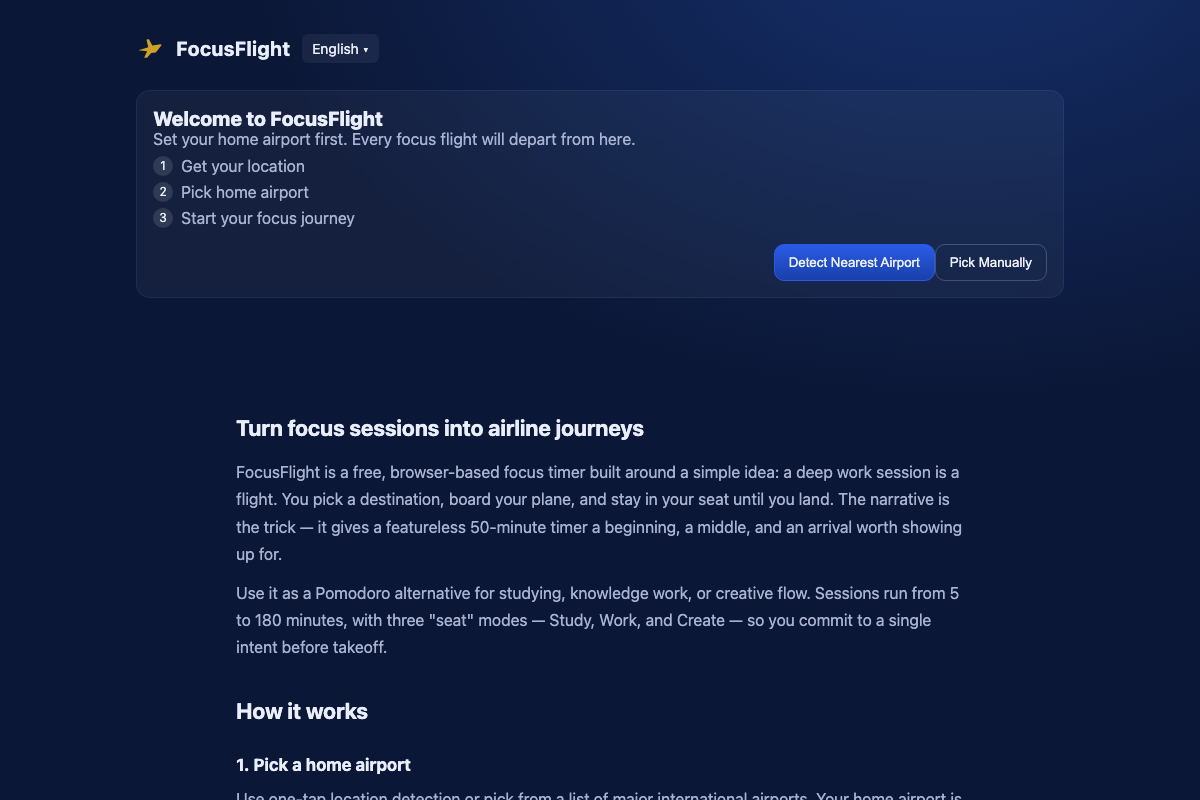
Choose a destination airport (which determines your focus duration), select your seat class (study, work, or create), and take off. Work until your flight lands.
Best for: Any study session where you want engagement, flexible timing, and a built-in reward system.
Why it works: FocusFlight combines the best elements of multiple techniques: the timed commitment of Pomodoro, the ambient sound benefits of noise masking, the visual feedback of progress tracking, and the motivational pull of gamification. The aviation metaphor transforms mundane study sessions into journeys with a clear beginning, middle, and end.
Unique advantage: The destination unlock system creates long-term motivation to maintain a consistent study habit, which is the single most important factor in academic success.
How to Choose the Right Technique
| Situation | Recommended Technique |
|---|---|
| Cannot start | 2-Minute Rule, then Pomodoro |
| Memorization | Spaced Repetition Timers |
| Deep writing or coding | 90-Minute Block or Flowtime |
| Multiple subjects in one day | Time Blocking |
| Breaks keep getting too long | Reverse Pomodoro |
| General study with low motivation | FocusFlight Method |
| Complex prioritization needed | Eisenhower Matrix + Timer |
Common Mistakes to Avoid
- Switching techniques too often. Give each method at least a full week before deciding it does not work for you.
- Ignoring breaks. Skipping breaks does not make you more productive. It leads to cognitive depletion and longer overall study times.
- Using your phone as a timer. Your phone is the largest source of distraction. Use a dedicated timer app or FocusFlight on your laptop with your phone in another room.
- Not tracking results. Keep a simple log of which technique you used, how long you studied, and how productive you felt. Patterns will emerge.
Frequently Asked Questions
Which study timer technique is best for exam preparation?
For exam prep, combine spaced repetition (for reviewing material over days and weeks) with Pomodoro or FocusFlight sessions (for daily study blocks). The combination addresses both short-term focus and long-term retention.
How long should I study without a break?
Research suggests that most people can sustain high-quality focus for 50-90 minutes before needing a break. The exact duration depends on the task difficulty, your fatigue level, and your experience with focused work. Start with shorter sessions and build up.
Do study timers really improve grades?
Structured study time consistently outperforms unstructured study time in academic research. A study in the journal Learning and Instruction found that students who used structured time management techniques scored significantly higher on exams than those who studied for the same total duration without structure.
Can I combine multiple timer techniques?
Absolutely. Many productive students use time blocking for their overall schedule, Pomodoro or FocusFlight for individual study blocks, and spaced repetition for review sessions. The techniques are complementary, not competing.
What if I cannot focus even with a timer?
If no timer technique helps, the issue might be environmental (too many distractions), physiological (poor sleep, diet, or exercise), or psychological (anxiety about the material). Address those root causes first. A timer is a tool, not a cure for underlying focus problems.