
People often talk about Pomodoro and time blocking as if they are competing productivity religions. One side says you should work in short sprints with regular breaks. The other says you should map your whole day in advance and protect larger chunks of time. That framing makes the choice sound bigger and more ideological than it really is. In practice, these methods solve different problems. Pomodoro is mainly a session design tool. Time blocking is mainly a schedule design tool. Once that distinction becomes clear, it is much easier to decide what belongs in your day.
This matters because many focus problems are not really motivation problems. They are structure problems. Someone might feel behind because their day has no shape. Another person might sit down with a schedule but still fail to begin because the first work block feels too large. A student may reserve three hours for studying and still spend the first forty minutes drifting between tabs because the block has no internal rhythm. A remote worker may use Pomodoro all day and still feel scattered because email, meetings, and deep work were never separated at the calendar level. The tool fails when it is asked to do a job it was not designed to do.
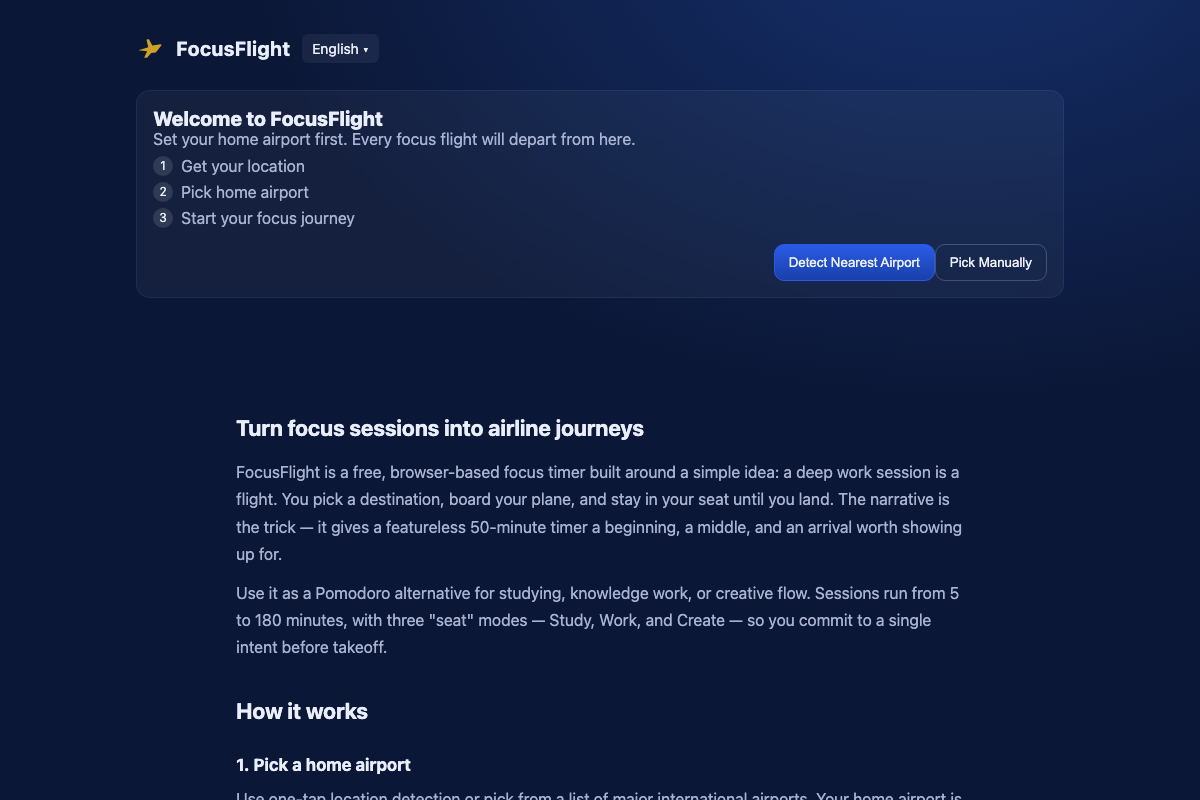
FocusFlight fits into this conversation well because it turns a chosen work interval into a defined environment. You are not just watching a countdown. You are creating a session with a beginning, a duration, and a sound bed that makes the block feel more stable. That works whether you prefer classic Pomodoro rounds or longer deep work sessions. The real question is not which method sounds more disciplined. The real question is which one matches the attention problem you are trying to solve.
Pomodoro and Time Blocking Are Not the Same Layer
The Pomodoro Technique is built around a simple cycle: work for a set interval, take a short break, and repeat. The classic version uses 25 minutes of work followed by a 5-minute break, then a longer break after several rounds. Its strength is obvious. A short block reduces resistance. Starting feels easier because the commitment is small, the finish line is visible, and the session has built-in recovery. For people who procrastinate because the task feels emotionally heavy, that matters a lot.
Time blocking works at a different scale. Instead of shaping one session, it shapes the day. You assign specific blocks of time to specific categories of work before the day gets noisy. That might mean reserving 8:30 to 10:00 for writing, 10:30 to 11:00 for email, 1:00 to 2:30 for studying, and 3:00 to 4:00 for meetings or admin. Cal Newport has written extensively about planning work with clear boundaries, and his overview of deep work is useful because it emphasizes that concentration needs protection, not just good intentions.
When people compare these methods directly, they often miss that one is about the shape of a block and the other is about the placement of blocks. That is why so many productivity debates produce confusion. Asking whether Pomodoro is better than time blocking is a little like asking whether a meal plan is better than a plate. One helps you decide when things happen. The other helps you decide how a single serving is structured.
What Pomodoro Does Better Than Time Blocking
Pomodoro shines when the biggest obstacle is activation energy. If a task feels boring, intimidating, unclear, or just annoying, a 25-minute commitment is easier to accept than a two-hour demand. Many students and knowledge workers lose time not because they lack free hours, but because they keep delaying the first move. The timer solves that by shrinking the psychological cost of beginning.
Pomodoro is also useful when you need frequent resets. Repetitive study sessions, flashcards, inbox cleanup, reading assignments, and routine admin often benefit from short, bounded effort. The break acts as a pressure release valve. You are less likely to wander off mid-task if you know the pause is coming soon. For people rebuilding focus after burnout, illness, a vacation, or a distracting week, that short-cycle rhythm can be much easier to trust than a long silent block.
Another strength is visibility. Pomodoro makes effort legible. Four rounds feels concrete in a way that vague intentions never do. This is especially useful for students who need to measure preparation honestly. Saying "I studied all afternoon" is imprecise. Saying "I completed three 25-minute review blocks and one 50-minute problem set block" gives you real information about how the time was used.
There is also a behavioral benefit. The method teaches people that breaks should be deliberate rather than accidental. Gloria Mark and colleagues' study of interrupted work (48 participants) reinforces a practical point: interruptions carry costs beyond lost minutes. Interrupted participants finished faster but reported more stress, frustration and effort. A planned five-minute break is not the same as ten unplanned context switches. Pomodoro does not eliminate distraction on its own, but it gives you a cleaner container for attention than most people create by default.
What Time Blocking Does Better Than Pomodoro
Time blocking solves a different and often bigger problem: drift. Without a plan for the day, work expands into whatever space looks easiest in the moment. Shallow tasks spread everywhere. Messages invade the morning. Small requests fragment the afternoon. By the end of the day, you may have felt busy the entire time without protecting even one serious block for meaningful work.
That is where time blocking becomes powerful. It forces prioritization before reactive inputs take over. If your calendar already says the first ninety minutes are for your hardest task, you are less likely to offer that space to email, meetings, or random cleanup. The method is especially helpful for remote workers and students balancing multiple responsibilities because it reduces constant renegotiation. You do not need to keep asking what to do next. The schedule already answered.
Time blocking is also better for mixed days. Most people are not doing one type of task for eight straight hours. A typical day might include deep work, review, planning, communication, errands, and breaks. Pomodoro can structure each piece, but it does not tell you how the pieces should fit together. Time blocking does. It lets you reserve your best cognitive hours for demanding work and push lower-value tasks into smaller containers later in the day.
There is also a realism advantage. A good time-blocked schedule acknowledges that energy changes. The morning may be right for analysis, writing, or exam prep. Late afternoon may be better for routine communication or light review. A schedule that ignores those energy patterns often looks disciplined but performs poorly in real life.
Where Each Method Breaks Down
Pomodoro starts to fail when the task needs a longer runway than the timer allows. Complex writing, coding, strategic planning, and difficult study often take time to warm up. If the block ends right when your thinking becomes coherent, the timer is now interrupting the very focus it was supposed to protect. Many people interpret this as a sign that they are bad at Pomodoro, when the real issue is that the work outgrew the classic interval.
Pomodoro also breaks down when people use it as a way to avoid defining the work. A timer is not a task. If you start a 25-minute block without deciding what output the session should produce, you will often spend the interval wandering through low-friction activity. The block feels productive because the timer is running, but the result is thin.
Time blocking has its own failure modes. The most common is fantasy scheduling. People create a day that looks efficient on paper and then discover it assumes perfect energy, zero interruptions, and unrealistic transition times. A rigid plan can become discouraging if one late start or one meeting causes the entire day to unravel.
The second failure mode is emotional friction at the block level. A time-blocked schedule might reserve 9:00 to 11:00 for writing, but that does not automatically make starting easy. If the task feels heavy, you can still spend the first half hour resisting it. The day has structure, but the session itself lacks a manageable entry point. This is exactly where Pomodoro can help inside the block.
| Method | Best For | Main Strength | Main Risk | Best Fix |
|---|---|---|---|---|
| Pomodoro | Starting, repetition, study sprints, low-motivation work | Reduces resistance and creates clear breaks | Can interrupt deep momentum | Stretch later rounds to 50 minutes when the work deepens |
| Time blocking | Planning the day, protecting priorities, balancing mixed tasks | Prevents drift and gives work a place on the calendar | Can become unrealistic or too rigid | Leave buffer space and revise blocks as the day changes |
| Combined approach | Most real workdays | Pairs calendar-level clarity with session-level traction | Requires a little setup before work begins | Pre-plan only the important blocks and keep the internal timer simple |
The Better Question: What Problem Are You Solving Today?
If you cannot start, Pomodoro is often the better first move. If you keep losing the day to reactive work, time blocking is usually the missing layer. If your attention is inconsistent because your environment is noisy or your phone is nearby, neither method will fully help until you improve the setup around the block.
That is why the best productivity systems start with diagnosis instead of loyalty. Are you dealing with procrastination, scattered priorities, unclear tasks, poor boundaries, or a bad environment? Those are different problems. The wrong tool can still produce activity, but it will not produce relief. A lot of frustration comes from using a scheduling method to fix a starting problem or using a timer method to fix a calendar problem.
For students, the distinction is especially useful. Time blocking can reserve specific windows for reading, retrieval practice, problem sets, and review across the week. Pomodoro can make each session easier to begin and less likely to sprawl. For remote workers, time blocking can separate deep work from meetings and communication, while Pomodoro can create a cleaner rhythm inside individual work sessions.
How to Combine Pomodoro and Time Blocking Without Overcomplicating It
The simplest hybrid system is this: time block your day at a high level, then use Pomodoro inside the blocks that need help with activation or pacing. Do not time every minute of the calendar. Reserve specific windows for important work, then decide whether the session should run as a 25-minute start, a 50-minute deep block, or a series of shorter rounds.
For example, imagine you reserve 8:30 to 10:00 for a hard writing task. The first 25 minutes can be a startup Pomodoro dedicated to outlining or drafting the ugliest first paragraph. Take a 5-minute break. Then move into a longer 50-minute block once the task is live. The schedule protected the morning. The timer lowered the cost of beginning. Together they solved two separate problems cleanly.
Another example works well for exam preparation. Block 7:00 to 9:00 PM for study. Use the first 25 minutes for recall warmup, the next 50 for problems or writing, and the last 25 for error review. You still planned the evening at the calendar level, but you gave the session internal structure matched to the task. That is usually more durable than trying to force the whole study block into identical 25-minute rounds.
The key is restraint. You do not need a complex color-coded operating system. You need a few protected blocks, clear outputs inside them, and timer lengths that fit the work. The more complicated the setup becomes, the more likely it turns into another form of procrastination.
How Sound and Environment Change the Result
People often compare productivity methods while ignoring the environment where those methods are being used. That leaves out one of the largest variables. A well-planned block can still fail if the room is erratic, your tabs are crowded, and your phone keeps offering tiny exits from effort. Structure is not only temporal. It is environmental.
This is where ambient sound can help. Consistent white noise, brown noise, or airplane cabin ambience can reduce the mental cost of unpredictable background noise, especially in shared homes, libraries, and open workspaces. The point is not to make work feel cinematic. The point is to stop your attention from reacting to every small change in the room. Guidance from the UNC Learning Center also supports the broader idea that effective study depends on active methods and intentional setup, not just more hours.
FocusFlight is useful here because it combines the timer with a stable sensory cue. When the session begins, the environment changes with it. That helps the block feel separate from the rest of the day. For some people, that boundary is what turns a good plan into a repeatable habit.
A Practical Default for Most People
If you want one straightforward recommendation, use time blocking to plan your priorities and Pomodoro to start the blocks that feel hardest to enter. Keep it simple. Reserve one or two meaningful focus windows each day. Inside those windows, define the output before you begin. If the task feels heavy, start with 25 minutes. If the work catches fire, extend the next round to 50 minutes or longer.
This works because it respects both the calendar and the mind. The schedule answers when the work happens. The timer answers how you will get traction once the block begins. Neither method has to carry the full burden alone.
The strongest productivity system is rarely the most impressive-looking one. It is the one that still works on an ordinary Tuesday when your energy is average, the room is not perfect, and you still need to make progress. That usually means fewer rules, clearer blocks, and a better match between the method and the actual problem in front of you.
Frequently Asked Questions
Is Pomodoro better than time blocking for studying?
Not by itself. Time blocking is better for deciding when study sessions happen during the week. Pomodoro is better for making a session easier to begin and easier to pace. Students usually get the best result by combining them.
Can I use time blocking without planning my entire day?
Yes. In fact, that is often better. Start by protecting only one to three important blocks instead of trying to script every hour. That gives you structure without making the day too brittle.
When should I stop using 25-minute Pomodoro sessions?
You do not need to stop using them entirely. Use them when starting is hard or when the task is naturally short. Shift to 50-minute or longer blocks when the work needs a deeper runway and the shorter timer keeps cutting off momentum.
What if my time-blocked schedule keeps falling apart?
Your schedule is probably too dense or too optimistic. Reduce the number of major blocks, leave transition room, and avoid assuming every hour will be high-energy. A realistic schedule is more useful than a perfect one that lasts until 10:15 AM.
Does background sound help both methods?
It can, especially if your environment is inconsistent. A steady sound layer does not replace clear planning or a good timer, but it can make either method easier to sustain by reducing the distraction cost of a noisy room.